Skip to content

2006

A Sudoku challenge generator

When on holiday, one can kill time solving Sudoku puzzles. When one has done a dozen of those puzzles and one happens to have a wandering mind like mine, one starts wondering how those Sudoku challenges are created, and if it would be possible to describe an algorithm that can make such a scarcely filled-in 9-by-9 grid. Some sunny hours later one has a system that might work (I haven’t implemented it fully yet). For my future reference: here’s how I would do it.
REMARK: this algorithm is quite logical and as such, I seriously doubt I would be the first one to think of it. I can imagine that Sudoku puzzles are already made by the hundreds with a program that uses this or a quite similar system. I’m not claiming it’s an original ‘invention’, just a fun problem to tackle.

Step 1: take a good root grid

Let’s start with an completely valid Sudoku filled-in grid. Any one would do, I take the one that has 1-2-…-9 in the top row, and in the top left 3×3 square:
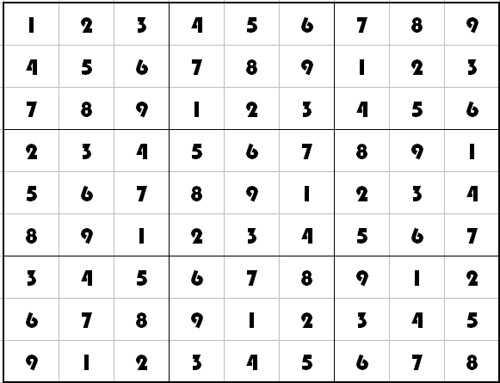
Step 1: start layout

Barcamp Brussels #2: on Sunday Sept 24th

We have just decided on the location and date for the new Barcamp Brussels:

WHEN: Sunday Sept 24th 2006 (back to back with EurOSCON, GovCamp and DrupalCON)
WHERE: Skynet Lounge, in K-NAL building next to Brussels harbour

As you can guess from the location, Skynet has been confirmed as the principal sponsor again (thx Bart and Clo), which allows us to provide a nice and stimulating surrounding for our speakers/attendees.
(…)

If you want to participate, the first thing you need to do is to add your name to:
http://barcamp.org/BarCampBrussels

via barcamp.forret.com

How to visualize a timeline

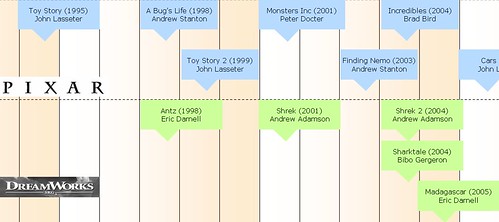
I am working on a timeline of animation movies: specifically to see when Disney started to fade and Pixar/Dreamworks took over. What films were made when, who made them and in what way do they coincide with activities of e.g. Steve Jobs. Oh, and to see where that new contender, Blue Sky Studios (“Ice Age”) fits in.

I first started out with Excel: I figured I’d have a bunch of dated events and throw a quick XY chart onto it. But that didn’t feel right. I then turned to Powerpoint and created a horizontal timeline, on which I could place blocks. That works OK for events that are far apart, but not for a quick succession, nor for events with a duration (from … to …). And, frankly, it looked rather ugly:
Timeline: animated movies

Which left me with two questions:

  1. how do other people create their timelines, and
  2. are there on-line tools that let me do it easily?

Trackback wizard for Blogger users

Trackbacks are a good way to alert other bloggers that you citing them on your blog. It also helps to drive traffic to your own site (if your comment was insightful or tempting).
Unfortunately, some blog hosts like Blogger, Skynetblogs do not automatically send a trackback ping to all the blog URLs in your blog post. So how do you send such a trackback from your blogspot.com site to other blogs (provided they support receiving them, obviously)?

Owner of the “Amen Break”

I (used to) have a blog called Sample Spotters that talks about whose songs have been sampled by whom. With the help of sites like the-breaks.com and datraxer.com, I make a list of an artist’s songs and where they were used: e.g. Roy Ayers, Patrice Rushen or Labi Siffre. I also did it the other way round once (what songs were sampled BY George Michael), and for some pivotal songs, I dedicated a whole blog post to just 1 song: Funky Drummer and the “Amen Break”.

Google and Perfect10: DMCA at its best

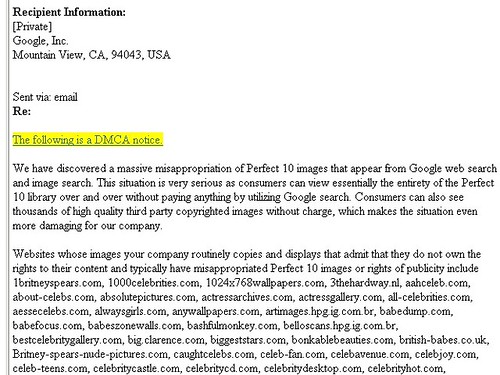
While searching for something really innocent on Google (honestly!), I got the following warning:
Google DMCA warning: OMG

The Digital Millenium Copyright Act (“DMCA” – 1998) criminalizes production and dissemination of technology that can circumvent measures taken to protect copyright, not merely infringement of copyright itself, and heightens the penalties for copyright infringement on the Internet. OMG, what kind of illegal practices had Google just protected me from? Clicking the ChillingEffects link shows the DMCA complaint in question: the Perfect 10

Google DMCA explanation: WTF

More fun with Myers-Briggs

I’ve been reading quitea lot on Myers-Briggs for my previous post “Myers-Briggs typology“, and some of it is too good not to post it here, so here is my second MBTI post! I’ve also made an new MBTI web tool for my web tools collection, that you can use to quickly check the facts for each type.

MBTI at first sight?

Get this: according to socionics, it is possible to do Visual Identification (V.I.) of the Myers-Briggs type. They prove it by showing 4 pictures (Malcolm McDowell, Sting, and two familiar actors-I-can’t-name) with -granted- similar features, and they’re all ISTJ (Sting a duty fulfiller?). I’ll be honest, I don’t buy this. I know that you can sometimes guess character traits from someone’s face (e.g. a ‘kind’ face vs. a ‘hard’ face), and I can understand how your physical attributes (pretty/ugly, thin/chubby) might influence your behaviour and consequently your MBTI type, but I’m not sure this method would withstand a critical scientific eye.
MBTI: visual identification

Myers-Briggs typology: I’m an ENFP

Background

I have never been a big believer in astrology. I am not convinced the location of stars at the moment of your birth is that important to your personality. I’m a Virgo, but I don’t feel that defines me that much. But some years ago I discovered a ‘labeling’ system that was based on the actual behaviour of a person, whose result was much more significant: the (Jung) Myers-Briggs Type Indicator (MBTI):

According to Jung’s typology all people can be classified using three criteria. These criteria are: Extraversion/Introversion – Sensing/Intuition – Thinking/Feeling
Isabel Briggs-Myers added a fourth criterion: Judging/Perceiving
from humanmetrics.com

A good explanation of each criterium is:

  1. Where, primarily, do you prefer to direct your energy?
    If you prefer to direct your energy to deal with people, things, situations, or “the outer world”, then your preference is for Extraversion. This is denoted by the letter “E”.
    If you prefer to direct your energy to deal with ideas, information, explanations or beliefs, or “the inner world”, then your preference is for Introversion. This is denoted by the letter “I”.
  2. How do you prefer to process information?
    If you prefer to deal with facts, what you know, to have clarity, or to describe what you see, then your preference is for Sensing. This is denoted by the letter “S”.
    If you prefer to deal with ideas, look into the unknown, to generate new possibilities or to anticipate what isn’t obvious, then your preference is for Intuition. This is denoted by the letter “N” (the letter I has already been used for Introversion).
  3. How do you prefer to make decisions?
    If you prefer to decide on the basis of objective logic, using an analytic and detached approach, then your preference is for Thinking. This is denoted by the letter “T”.
    If you prefer to decide using values and/or personal beliefs, on the basis of what you believe is important or what you or others care about, then your preference is for Feeling. This is denoted by the letter “F”.
  4. How do you prefer to organise your life?
    If you prefer your life to be planned, stable and organised then your preference is for Judging (not to be confused with ‘Judgemental’, which is quite different). This is denoted by the letter “J”.
    If you prefer to go with the flow, to maintain flexibility and respond to things as they arise, then your preference is for Perception. This is denoted by the letter “P”.

from teamtechnology

Estimating real-time traffic speed

— This is a post from 2006. Back then, there was no Google Maps, no Waze, no iPhone, no mobile data —

I was reading a magazine on affordable GPS systems and one of the features they stressed a lot was the support for TMC (Traffic Message Channel). This is the reception of real-time traffic info that is digitally transmitted alongside an FM channel. So I wondered where that data came from: how sophisticated the traffic detection schemes were.