Skip to content

2006

Invent, don’t inhibit

1982

25 years ago, the last real proof of innovation coming from the recording industry:

In 1979 Philips and Sony decided to join forces, setting up a joint task force of engineers whose mission was to design the new digital audio disc. Prominent members of the task force were Kees Immink and Toshitada Doi. After a year of experimentation and discussion, the taskforce produced the “Red Book”, the Compact Disc standard. (…)
According to Philips, the Compact Disc was thus “invented collectively by a large group of people working as a team.”
from en.wikipedia.org/wiki/Compact_disc

Three years of constructive working and a new technology was developed that was revolutionary superior.

In August 1982 the real pressing was ready to begin in the new factory, not far from the place where Emil Berliner had produced his first gramophone record 93 years earlier. (Deutsche Grammophon, Berliner’s company, had by now become a part of PolyGram). The first CD that was pressed in Hanover was a recording of Herbert von Karajan conducting the Alpine Symphony by Richard Strauß. In January 1983, 500 working days after the start of production, half a million CDs had been made.
from research.philips.com

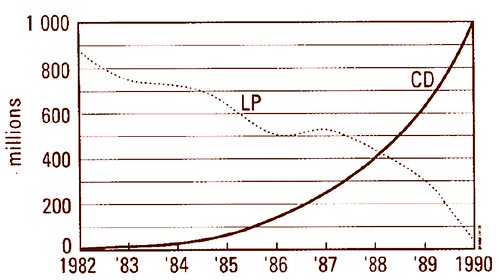
The CD was an instant hit and made a lot of companies a lot of money:
CD versus LP

Barcamp Brussels: when the day is done

And what a day it was! It went by in a rush, without any major mishaps and with lots of smiling people all around. Me, I just ran around on adrenaline and cafeine (probably equal parts), while catching only the occasional 5 minutes of a speech here and there. But at the end of the day: it was a great atmosphere with lots of interesting topics and charming people eager to learn and share. It was everything I hoped it would be, so I’m a happy man.

Yesterday I was browsing through my freshly arrived Tufte book “The visual display of quantitative information“. One example of “garbage in, garbage out” that he gives is the London Stock Exchange index (which went way down one year in Dec) and the solar radiation in that same year (which obviously also went down in the winter). Plotting both lines in the same graph gives the impression of correlation (Stock Exchange went down because of lack of sun).

Now take a look at this chart:
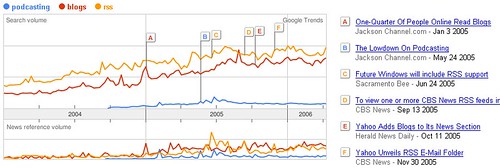
Google Trends: RSS

This seems to imply that, since the term “RSS” is more searched for than “blogs”, that RSS is more popular than this whole “blogs” thing, right?

And this is exactly what was written in businessweek.com. It was cited by socialsoftware.weblogsinc.com, who -to their credit- added the wise remark that:

To be honest, I do think that RSS is as important as I said above, but in terms of use frequency it’s also got the semantic advantage of only having one tense. People will write about and search for blogs, blog and blogging for example – but RSS is a one-term wonder.

Mission Impossible III: largest digital release ever

Add one more superlative to Paramount’s “Mission: Impossible: III”: it is the largest digital release ever, playing on more than 170 digital cinema screens throughout North America. And all digital preparation and distribution to those screens was handled by Kodak Digital Cinema.
from http://www.dcinematoday.com/dc/pr.aspx?newsID=487

Mission Impossible III
(Digital cinema is obviously of much better quality than this pixelized image – this just says “digital”, doesn't it?)

Database war stories: DB vs _square_ files

Plug and PlayI’ve been following the Database War Stories of O’Reilly Radar: how companies use text-based alternatives to classic relational database systems in order to cope with huge volumes. Check out the stories of Findory/Amazon, Google File System, Flickr and Second Life. Anyway, this seemed like a good moment to share some of my database war stories. Let me take you back to the early nineties.

1993 @ Ukkel
I arrive at Sopres, one of the larger direct marketing / database management companies in Belgium. Fresh from university (and 1 year of military service), I expect to see RDBMS everywhere and dive into SQL. Imagine my surprise when I see that, yes, there are a lot of Sybase SQLServer databases around, but the bulk of the work is done with something they call ‘square files’ (see below). They have built a whole set of tools to work with those and by using them myself, I learn to appreciate the advantanges of the system (speed, mainly) and grow a fairly accurate intuition for things like queries, indexes and outer joins.

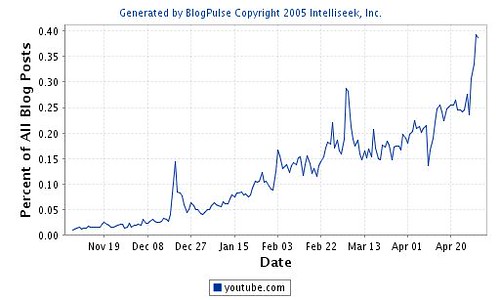
Youtube bandwidth: terabytes per day

Youtube (Blogpulse)
Youtube seems to be losing some of its early adopters: Coolz0r quits the service, while Nathan even embarks on a grassroots activism mission to ruin the company (by getting its most popular uploaders banned – I have mixed feelings about that one). The issue is: to protect themselves from lawsuits, Youtube is taking the approach of deleting videos and even users upon first suspicion of (copyright) problems. They already received an ultimatum from NBC in Feb, then a proof to Jason Calacanis that it was ‘not a real business‘.

Youtube traffic
What I found interesting in the whole controversy are the astounding numbers that popped up: # videos shown per day, bandwidth usage, bandwidth costs. Get ready for some big numbers: