My quest for Let’s get lost - Chet Baker by Bruce Weber
Let’s Get Lost (1988) is a American documentary film about the turbulent life and career of jazz trumpeter Chet Baker written and directed by Bruce Weber.
I subscribe to less and less podcasts (not enough time to listen), but there is one I always install on every newly installed iTunes. It’s called the Basic Soul Radio Show, it’s presented by Simon Harrison. Every week Simon selects two hours of old and new funk, soul and electronic music, which makes for a 200MB MP3 every time (upgrade that hard disk!). I have discovered lots of little pearls thanks to it. Some examples from the top of my head:
I want to mention a little tool that helped me out twice in the last week, and that I find very little info about online. It’s a Windows command-line MP3 file tagger and renamer called id3.exe. Since I forgot where I downloaded it from and Google doesn’t give me a clue either: here’s where you can download id3.exe.
ID3.exe can do several things, of which I will just cite the things I actually used:
id3.exe -1 -2 -g [genre] -c "[Copyright notice]" -l "[Album name]" "%OUTPUT%"id3.exe -D %INPUT% -1 -2 "%OUTPUT%"id3.exe -2 -f "%%a - %%l - %%t.rbs" "%OUTPUT%"Arno and his deep-philosophical reflections on life, music and being paid.
This week in my newspaper: there’s a re-issue of the fabulous “Steve McQueen” album (1985) by Prefab Sprout. Prefab Sprout is: songwriter Paddy McAloon on vocals, guitars, keyboards, Martin McAloon on bass, Wendy Smith on backing vocals, guitars, Neil Conti on drums. It was one of the first vinyl records I ever bought and certainly one of the best. The quality of the album might have something to do with the producer: Thomas Dolby.
Big surprise: instead of having to look for the lyrics on some shady spyware-infested illegal site, you can find them right there on the Prefab Sprout site:
My love and I, we are boxing clever
She’ll never crowd me out
Fall be free as old confetti
And paint the town, paint the town
(When Love Breaks Down)
What does it mean? I have no idea.
For those of you for who the group name does not ring a bell, here’s some videos, taking you back, all the way to the eighties!
“When love breaks down”
 OK, this post will give away my age: I went to a Level 42 concert. For those of you born after 1980: Level 42 was quite popular between ‘81 and ‘88. They make music that can be described as funky pop. Their lead singer, Mark King, is also a bass guitar pop-n-slap virtuoso. Up til that moment, bass acrobatics could mostly be found in jazz circles: Marcus Miller, Stanley Clarke and (more recently) Victor Wooten. Mark King not only took the technique to a mainstream audience, the guy actually sang while doing amazing stuff on the bass.
 I wrote a post last year “REQ: Live mashup performance tool” on how much fun it would be to be able to do live mashups: mix basslines, drums, guiter riffs and vocals from different songs in real-time. I just found out via beatmixed that there is a New-York DJ that has figured out the nuts and bolts: Toto a.k.a. Moldover.
See him at work on this Youtube video:
 Pukkelpop is the last of the big summer festivals, and for me, the best. It might be the Limburg influence, something in the water, or the relaxed guidance of its founder, Chokri Mahassine, but everyone working at the festival seems to be so happy and aiming to please.
I spent most of my time there at the press lounge, in the pleasant company of Clo, Zabine, Bart, Ben, Gunther, Sylvie, Lien, Vanessa and so many others. I also received a much-too-short massage from Tamara at the Coca-Cola booth. Clo has pictures, so they’re bound to show up at some moment.
I (used to) have a blog called Sample Spotters that talks about whose songs have been sampled by whom. With the help of sites like the-breaks.com and datraxer.com, I make a list of an artist’s songs and where they were used: e.g. Roy Ayers, Patrice Rushen or Labi Siffre. I also did it the other way round once (what songs were sampled BY George Michael), and for some pivotal songs, I dedicated a whole blog post to just 1 song: Funky Drummer and the “Amen Break”.
25 years ago, the last real proof of innovation coming from the recording industry:
In 1979 Philips and Sony decided to join forces, setting up a joint task force of engineers whose mission was to design the new digital audio disc. Prominent members of the task force were Kees Immink and Toshitada Doi. After a year of experimentation and discussion, the taskforce produced the “Red Book”, the Compact Disc standard. (…)
According to Philips, the Compact Disc was thus “invented collectively by a large group of people working as a team.”
from en.wikipedia.org/wiki/Compact_disc
Three years of constructive working and a new technology was developed that was revolutionary superior.
In August 1982 the real pressing was ready to begin in the new factory, not far from the place where Emil Berliner had produced his first gramophone record 93 years earlier. (Deutsche Grammophon, Berliner’s company, had by now become a part of PolyGram). The first CD that was pressed in Hanover was a recording of Herbert von Karajan conducting the Alpine Symphony by Richard Strauß. In January 1983, 500 working days after the start of production, half a million CDs had been made.
from research.philips.com
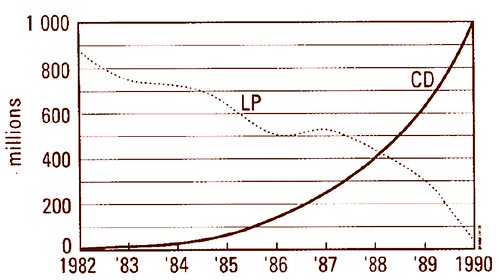
The CD was an instant hit and made a lot of companies a lot of money:
I remember when I started DJ’ing and going to parties (that would be the previous century, yes) that we used to have this whole ‘slow-dancing’ routine. Every couple of hours the DJ would play ‘La Bamba‘, sweaty teenagers would check each other out for a quick dance and a stolen kiss (on the cheek), and then there would be 3 to 5 ballads, or ‘slows’. Fifteen minutes of one boy slow-dancing with one girl. For those of you who have never done that: with the right kind of partner it is awesome.