Reinventing the wheel: Twitter backchannel
I was chatting a bit with Bart about Barcamp, and I asked the inevitable question: “Should we do something with Twitter?” To which Bart’s answer was: “Maybe, but what?”. Let’s see:
Yahoo! Pipes is an RSS mashup application from Yahoo. It allows you to merge, sort, filter and combine RSS feeds. Since it is primarily a remix/mashup application, I’ve tried to list its features in my Get-Mix-Deliver model:

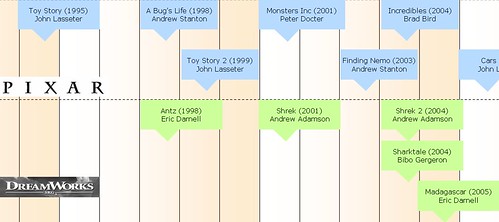
I am working on a timeline of animation movies: specifically to see when Disney started to fade and Pixar/Dreamworks took over. What films were made when, who made them and in what way do they coincide with activities of e.g. Steve Jobs. Oh, and to see where that new contender, Blue Sky Studios (“Ice Age”) fits in.
I first started out with Excel: I figured I’d have a bunch of dated events and throw a quick XY chart onto it. But that didn’t feel right. I then turned to Powerpoint and created a horizontal timeline, on which I could place blocks. That works OK for events that are far apart, but not for a quick succession, nor for events with a duration (from … to …). And, frankly, it looked rather ugly:
Which left me with two questions:
Yesterday I was browsing through my freshly arrived Tufte book “The visual display of quantitative information“. One example of “garbage in, garbage out” that he gives is the London Stock Exchange index (which went way down one year in Dec) and the solar radiation in that same year (which obviously also went down in the winter). Plotting both lines in the same graph gives the impression of correlation (Stock Exchange went down because of lack of sun).
Now take a look at this chart:
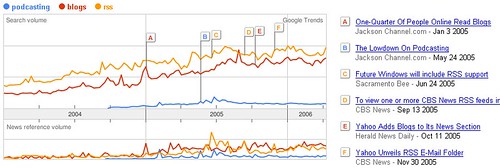
This seems to imply that, since the term “RSS” is more searched for than “blogs”, that RSS is more popular than this whole “blogs” thing, right?
And this is exactly what was written in businessweek.com. It was cited by socialsoftware.weblogsinc.com, who -to their credit- added the wise remark that:
To be honest, I do think that RSS is as important as I said above, but in terms of use frequency it’s also got the semantic advantage of only having one tense. People will write about and search for blogs, blog and blogging for example – but RSS is a one-term wonder.
 Background
I read a lot of info on digital cinema these last months. I find there is little syndicated content (blog feeds) to be found on the topic. Some sites have a page of press releases and/or an email newsletter, but that’s about it. That’s why I have created some custom RSS feeds with feed43. (e.g. Digital Cinematography feed for the CMP Digital Cinematography Magazine)
What I do see is that some sites publish really nice magazines in PDF (Portable Document Format – by Adobe) format (see Videography on the right). You only know about these if you go visit the site of course – very Web 1.0. So if there could be a feed that alerts me of new issues of these PDF files … And while we’re at it, why not put the PDF link as an enclosure in the RSS feed, podcast style? And just like an MP3 podcast is automatically transferred to a portable MP3 player, could a PDF podcast be automatically printed? The answer is: Yes. Let me show you how.
While playing with Feed43 recently (an excellent anything-to-RSS converter), I wondered: why doesn’t Feedburner do any of this stuff? It’s just a bit earlier in the RSS food chain (let’s call that the ‘feed chain’). Which of course incentivised me to put that feed chain on paper. This is the result:

I had an idea recently that I probably won’t be able to work out, so I’m just gonna throw it here and see if anyone feels like putting the nuts and bolts together.