Skip to content

science

Interpersonal Intelligence and Mental Violence

This is a text by Rauno Lindström that has now disappeared from its original URL. I don’t agree with all points in the text, but I store it here for easy reference. The definition of ‘interpersonal intelligence’ will remind you of “EQ“.

Arguments for the existence of a kind of intelligence which codes how a person understands the feelings, the responses, and the behavior of the others, was brought forward by Gardner (1985). He defends extensively this ability which he calls the interpersonal intelligence but he does not give any definition for it. I argue for one meaning which the definition should contain. My insight is based mainly on experience, very little on the psychological literature because I am a physicist. I try to illuminate my ideas by a few examples from everyday life. My view of the interpersonal intelligence consists of similar aspects as the social intelligence by Barnes and Sternberg (1989). They defined the social intelligence as consisting, in part, of the ability to accurately decode social information. The testees were given two tasks. First, they had to judge whether a couple pictured in a photograph was real (genuinely in a relationship) or fake (two strangers). Second, they were asked to judge which of two people in a photograph was the other’s supervisor. However, I wish to emphasize that the interpersonal intelligence does not really become apparent in the test items where the testee is to react only to the behavior of another person. In fact, testees possessing quite different interpersonal intelligences would response in a very similar way. The interpersonal intelligence becomes discernible when the testee self is involved in the matter. It shows the extent to which a person is willing to take into account the viewpoints of the other persons versus his or her own viewpoint. I think that it is possible to predict very well this kind of behavior of an individual if one has known him or her for a long time.

A Sudoku challenge generator

When on holiday, one can kill time solving Sudoku puzzles. When one has done a dozen of those puzzles and one happens to have a wandering mind like mine, one starts wondering how those Sudoku challenges are created, and if it would be possible to describe an algorithm that can make such a scarcely filled-in 9-by-9 grid. Some sunny hours later one has a system that might work (I haven’t implemented it fully yet). For my future reference: here’s how I would do it.
REMARK: this algorithm is quite logical and as such, I seriously doubt I would be the first one to think of it. I can imagine that Sudoku puzzles are already made by the hundreds with a program that uses this or a quite similar system. I’m not claiming it’s an original ‘invention’, just a fun problem to tackle.

Step 1: take a good root grid

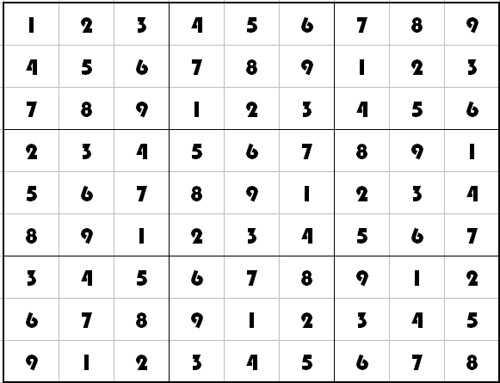
Let’s start with an completely valid Sudoku filled-in grid. Any one would do, I take the one that has 1-2-…-9 in the top row, and in the top left 3×3 square:
Step 1: start layout

Yesterday I was browsing through my freshly arrived Tufte book “The visual display of quantitative information“. One example of “garbage in, garbage out” that he gives is the London Stock Exchange index (which went way down one year in Dec) and the solar radiation in that same year (which obviously also went down in the winter). Plotting both lines in the same graph gives the impression of correlation (Stock Exchange went down because of lack of sun).

Now take a look at this chart:
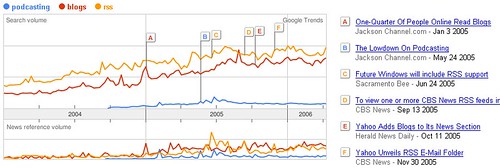
Google Trends: RSS

This seems to imply that, since the term “RSS” is more searched for than “blogs”, that RSS is more popular than this whole “blogs” thing, right?

And this is exactly what was written in businessweek.com. It was cited by socialsoftware.weblogsinc.com, who -to their credit- added the wise remark that:

To be honest, I do think that RSS is as important as I said above, but in terms of use frequency it’s also got the semantic advantage of only having one tense. People will write about and search for blogs, blog and blogging for example – but RSS is a one-term wonder.

BMI is not perfect

I’ve written a post on the BMI (Body Mass Index) of the candidates for Germany’s next Top Model and I have been mentally bugged ever since. Not by images of thin girls, but by the formula of BMI: weight(kg) / length(m) ^ 2 = kg/m².

Why the square of the length?

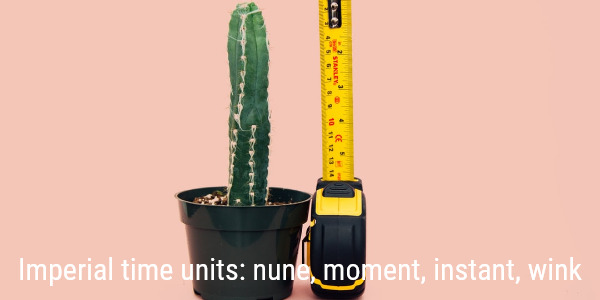
BMI measurement
BMI measurement

If the formula were weight/length you can attach a mental image to that: if you took horizontal slices of the body, how much would a 1m high slice weigh? For weight/length³ you can have an image too: kg/m³ or density of the body.

But BMI is kg/m² or something like ‘pressure’ (multiply it with gravity 9.81 m/s² and you get the unit of pressure: Newton/m² or ‘Pascal’).

Intelligence is the mind’s worst enemy


If you’re interested in high level conversations on a wide range of topics, check out edge.org. Their motto: To arrive at the edge of the world’s knowledge, seek out the most complex and sophisticated minds, put them in a room together, and have them ask each other the questions they are asking themselves.
There’s fascinating stuff about quantum computing and black swan dynamics, but a piece in the last publication jumped out, a discussion on ‘A self worth having’: