Skip to content

Peter Forret

.eu domain speculation

When the .eu domains became available to the general public, I decided I did not want forret.eu. That means that the domain was available to be grabbed by someone else, and indeed it has been. I received the following email today:
.EU domains businessmodel
This has all the professional charm of the mafia offering “protection”. The guy hides behind the Gmail of Luxembourg, kmail.lu . A DNS search shows me that KJ stands for Kurt Janusch from G-1 Ltd, 175-177 Newland Avenue, HU5 2EP, Hull UK. His name also shows up in a Eurid dispute (Eurid is the registrar that manages the .eu domains), but with an address in Germany. In another dispute with Altova, he is considered to have registered a domain name “without rights or legitimate interest in the name and in bad faith”.

MRTG data in XML format

Get ready for a lot of acronyms in this post: “How to create a good XML-based API for MRTG sensor data”.

MRTG

MRTG (Multi Router Traffic Grapher) is a tool to monitor the traffic load on network-links. It is widely used around the world to generate web pages containing images that provide a live visual representation of this traffic. MRTG is mainly a Swiss open-source product written by Tobias Oetiker from ETH Zurich with some help from others.

When used in its basic form (without RRDTOOL), it generates output like the following:
Flickr: #photos per hour

MRTG “API”

While MRTG was developed with network devices (routers) in mind, it can be used to show the trend of any numeric value over time. For that, it has a very simple input API: it expects 4 lines of text:

Line 1: current state of the first variable, normally 'incoming bytes count'
Line 2: current state of the second variable, normally 'outgoing bytes count'
Line 3: string (in any human readable format), telling the uptime of the target.
Line 4: string, telling the name of the target.

(*)
So there’s maximum 2 variables, which should be the same order of magnitude (or the automatic scaling of the Y-axis will make the smaller one undistinguisable of 0). The uptime and name show up in the “at which time ‘rou-rz-gw.ethz.ch’ had been up for 160 days, 8:02:55.” in the header of the HTML page.

MRTG in XML

In this world of REST, XMLRPC and SOAP interfaces, this seems so limited. Let’s try to make an XML format that allows the following:

  • it should minimally contain the four data lines cited above
  • it should be possible to add any parameter that influences the MRTG result (HTML and/or image) so that the XML as such is enough to define the whole MRTG configuration

This could be a minimal implementation:

Lots of New Year’s pictures

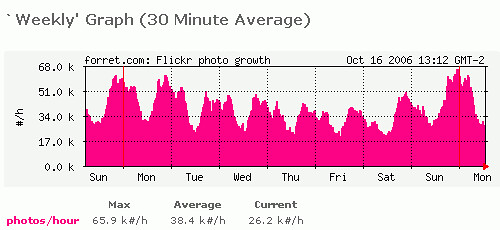
Lots of people have been taking pictures on New Year and this clearly shows in the stats of incoming pictures at two major photo hosting sites: Flickr and Smugmug.
Flickr reached a peak of nearly 100.000 pictures/hour (97.1 k#/h) and Smugmug a quarter of that (22.7 k#/h). That is 50% to 100% more than regular days.

LeWeb3: the Babel effect

I went to see the movie “Babel” recently, and I liked it a lot. At some point I was asked “what is it about?” The best I could come up with is “bad judgement”. If you still plan on seeing the movie, skip the next paragraph (spoiler).

Megapixel myth nuances

What’s the value of more megapixels? Is 10 megapixels better than 5? Here are some articles stating the opposite:

On the show, we did a test. We blew up a photograph to 16 x 24 inches at a professional photo lab. One print had 13-megapixel resolution; one had 8; the third had 5. Same exact photo, down-rezzed twice, all three printed at the same poster size. I wanted to hang them all on a wall in Times Square and challenge passersby to see if they could tell the difference.
(…)
I’m telling you, there was NO DIFFERENCE.
The Truth About Digital Cameras (NYT)

Megapixel apples and oranges
A 5-megapixel image that was created by down-sampling a 13 megapixel original is not the same as a 5-megapixel original. Why?
Well, let’s take a look at how a digital camera CCD sensor works. Natively the sensor is color-agnostic: pixels only measure light, not color. So the chip can only do greyscale images. A smart guy from Eastman-Kodak, Dr. Bryce E. Bayer, has however found a way to add color-sensitivity, by adding an RGB color filter array (the Bayer filter). Each pixel has a filter in front of it that lets through either the Red, Green of Blue light. Since the human eye is most sensitive to green, 50% of all pixels measure green, 25% do red and another 25% blue. A 5-megapixel image from the sensor is really a 2.5 MP green image, a 1.25 MP red and a 1.25 MP blue image, the three of them almost overlapping (1 pixel off). This is how the image is stored in RAW format. Each such pixel has a value between 0 and 4096 (12 bits). To convert it to a full-color image (8-bit value for each color R-G-B, so 24 bits for each pixel), the missing colors for each pixel are derived from the neighbouring pixels (aka demosaicing). E.g. a Red pixel has the exact value for the colour red, gets the green component from 4 neighbouring green pixels and the blue one from 2 neighbouring pixels. (More advanced algorithms exist) This gives some false colors (‘artefacts’) at sharp edges. Let’s simulate this with a pure black/white border:
Photography: RAW to JPG conversion

A pixel in a native 5-megapixel JPG image is based on 5 to 7 pixels of RAW color info. A pixel in a 5-megapixel camera that was downsampled from a 13MP image, gets its color info from roughly 20 pixels of original info. So the colors are more correct (provided the original picture was good quality, of course). Also, the color artefacts around sharp edges are much thinner so that they may almost disappear after the resizing.
Photography: RAW to JPG conversion
My point being: printing out a resized 5MP picture is not an honest comparison.

Digital cinema advertising and me

Najwa Nimri - Paz Vega
Those of you who have been reading this blog for a while, might have seen some posts on “digital cinema“. I have been researching the topic for more than a year now. And for a reason, of course: it seemed like the right kind of business for me, at the right moment (i.e. the really early days). And well, now I’ve actually found a way to make it into my day-time job.

Mark King plays a mean bass

Mark KingOK, this post will give away my age: I went to a Level 42 concert. For those of you born after 1980: Level 42 was quite popular between ‘81 and ‘88. They make music that can be described as funky pop. Their lead singer, Mark King, is also a bass guitar pop-n-slap virtuoso. Up til that moment, bass acrobatics could mostly be found in jazz circles: Marcus Miller, Stanley Clarke and (more recently) Victor Wooten. Mark King not only took the technique to a mainstream audience, the guy actually sang while doing amazing stuff on the bass.

Canon 400D

Canon cameras on Flickr

The new Digital Rebel

It might be me, but it’s like everyone around me is buying the new Canon 400D. OK, that’s exaggerated, but I’ve spotted at least 2 people I know per week in this last month.

At €739 for a 10 megapixel digital SLR, it’s a sweet deal. The ‘old’ 350D (now €649) was already a really nice camera, but the added resolution (10 MP instead of 8 MP), the EOS Integrated Cleaning System and certainly the larger screen will probably make this one even a bigger best-seller. Which means I will have to cope with a lot of “Yours has only 8 megapixels? Mine has 10!” For the record: that doesn’t matter!

We blew up a photograph to 16 x 24 inches at a professional photo lab. One print had 13-megapixel resolution; one had 8; the third had 5. Same exact photo, down-rezzed twice, all three printed at the same poster size. (…) I’m telling you, there was NO DIFFERENCE.