Skip to content

Peter Forret

More globalisation, please

A while back I bought the whole suite of Edward Tufte books: “The visual display of quantitative data“, “Envisioning Information” and “Visual Explanations“.

Today my copy of “Beautiful evidence” arrived in the mail. Actually a Belgian Post employee came to drop it off, because I had to pay 10 euro douane/customs. For a book of $52, that is an unpleasant extra 25%.

Beautiful Evidence: by Edward Tufte

The legislation that was printed on the back of the receipt states that any item from outside the EU, with a value higher than 22 euro, or not conform to ‘small letter mail of non-commercial kind’ (up to 45 euro), or containing goods from outside the EU should be presented to customs. Standard fee: 10 euro. I have just ordered a t-shirt from SomaFM ($50), I wonder what customs will think of that.

Moldover: Live mashup DJ

Moldover: live mashup DJI wrote a post last year “REQ: Live mashup performance tool” on how much fun it would be to be able to do live mashups: mix basslines, drums, guiter riffs and vocals from different songs in real-time. I just found out via beatmixed that there is a New-York DJ that has figured out the nuts and bolts: Toto a.k.a. Moldover.

MOLDOVER SETUP

  • HARDWARE: He uses a PC laptop with Ableton Live (for loop control) and Native Instruments Reaktor (for sound FX). As MIDI-controller, he uses a Novation ReMOTE 25 (2 octaves). For audio output he uses an Echo Audio Indigo » io CardBus interface.
  • SOFTWARE: he has organized an extensive collection of loops in Live into 8 columns or channels – I think “DJ1”, “DJ2”, “Beats”, “Percussion”, “Melody”, “Bass”, “Ambient” and “Vocals”. Loops are color-coded for the key they’re in (if any). Each channel has 1 FX configured which is the Reaktor plugin. There are also some effects on the master output (limiter, compressor, …)
  • CONTROL: he uses the 8 white keys at the right to trigger each channel. The 8 sliders, which are nicely lined up right above the keys, control the volume of each channel. The 2 x 8 knobs control 2 FX settings per channel. On some channels these are equalizer settings (cut-off frequency), on others delay/reverb settings (depends on the type of ‘content’ of each channel, and what FX go best with that).

See him at work on this Youtube video:

Easy web page mockup tool

I’ve just finished a tool to make web page mockups. The purpose: make a quick draft of what a web page should look like, so you can include a screen shot in an email or a specifications document. When a client describes what page layout he wants in pure text, it is easy to misunderstand what he means. E.g. “two levels of menu should be visible on each page“. Ok, you want those as a bullet list in the side bar or a breadcrumb on top? It’s easier to just show him an overview of: that block goes there, that’s what I mean with two sidebars on the right, the tags are here at the right, under the recent comments.

Intrusive Google ads on Sourceforge

Intrusive Google ads on Sourceforge
Come on, I can understand Sourceforge needs the Adsense revenue, but this is going too far. A huge 450 x 400 blue advertisement is blocking access to most download links on a Sourceforge download page, and there is no way to make it disappear, no [X] button in the top right or a “hide this” link.

Youtube for PDF: embedding documents

PDF Documents

Playing around with embedded Google calendars and reading “Google Apps and the power of embedded functionality“, I got to thinking: what would be other good candidates for a 1-click-embedding provider of other types of documents. I wondered e.g. whether there was something like Youtube for audio (yes, there is. GoEar.com is one example). But then I thought of a document type we all have learned to love and hate: Adobe’s Portable Document Format or PDF.

The idea behind the PDF file format is valuable: create a cross-platform standard for exchanging and printing documents that includes the text, images, fonts and their layout. The Acrobat Reader is a free application, and while Adobe’s PDF Writer is a commercial product (from $299), there are enough free alternatives to counter that. The thing is: PDF is great for printing, but not for browsing.

When you click on a PDF link, one of multiple things might happen:

  • If the web server does not send a header “Content-Type: application/pdf“, your browser has no clue what to do with the file: it will let you download the file and that’s all
  • if Acrobat is not installed, you can also only download the file, because your browser will not know what to do with files of type application/pdf
  • if Acrobat is installed, but you work with a browser that is not tightly linked to the OS (e.g. Firefox on Windows), it still might not open in Acrobat.
  • if your browser has configured Acrobat as a helper application, the file will download and will then be opened with the reader. So you will have 2 applications open: your browser and Acrobat Reader. This is actually the best method.
  • With Internet Explorer on Windows, Acrobat will open inside your browser, and your menu bar will become an interesting mix of IE and Acrobat options. (Where is the print button? Ah-ha!!) When you close the browser, a copy of Acrobat will continue to run in an invisible way, taking up some 32MB of memory
  • If you had no indication how big the PDF file was, you might be fiddling your thumbs for the next 5 minutes while the document is being downloaded.
  • If the document uses fonts that you don’t have, you might be looking at a very weird layout

So you are screwed if you don’t have Acrobat, if it is a really big document or if you access through a misconfigured browser. This is the equivalent of clicking on a .AVI movie file without a clue of how big the movie is, whether you have the necessary audio and video codecs to see it, and whether it’s worth it. If that was largely solved by a service provider like Youtube, what would a similar service for .PDF files look like?

Colorbar: belgian spam

Colorbar: belgian spamIn the last three days I have received 3 mails from Colorbar, a “lively private club for colorful people”. The first one didn’t trigger my suspicion, since I am subscribed to some music-related mailing lists. The two next mails came for 2 @forret.com aliases of which I am certain they never subscribed to any list. So I took a closer look at the email. No contact details are given, no indication of where the email addresses came from, no possibility to unsubscribe, i.e. it’s a spam mail. To be even more specific: a belgian spam message.

How to upsize an image

Printing in larger sizes

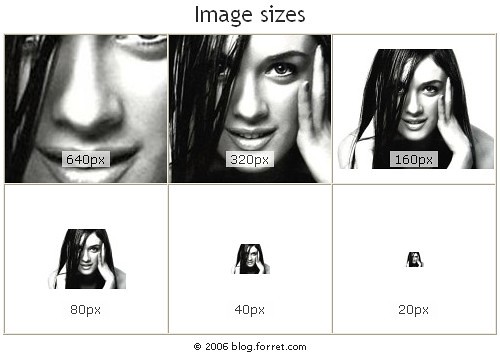
I have a Canon 350D digital camera. At 8 megapixels, it’s in the semi-pro league, and allows me to make 293mm x 192mm (11.5″ x 7.7″) hi-quality prints. That’s slightly smaller than an A4 (or Letter) sheet. Imagine now I would want to print on an A0 format or 1189mm x 841mm (46.8″ x 33.1″). That’s 16 times as big (height x 4 and width x 4). I could take a ‘normal’ image and rescale it to that size, but what would that look like? For every 16 pixels of the new picture, 1 would be an original one, and the other 15 would have been guessed from that and the surrounding pixels. This process is called image interpolation and there are different algorithms to do this. Let me show what that looks like.

Interpolation algorithms

Image sizes

Tangotation: writing tango steps

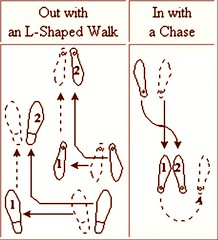
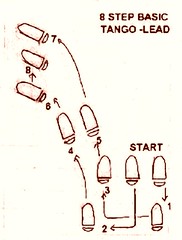
I have been looking for a way to write down tango steps since I began dancing. I experimented with drawing arrows, writing full text, abbreviations, inventing signs, … I’m not alone in this quest:
Tango notation: larrydla or Tango notation: nfo.net

And that is only when you take into account the feet. The Labanotation system (developed by professional dancers) has a graphical element for each movement of the legs and arms.
Labanotation: dance notation
While this is probably one of the best systems around, it’s too complicated for us laymen dancers. So I decided to distill a base vocabulary for writing down tango steps: Tangotation.