Skip to content

Peter Forret

Pukkelpop 2006

Pukkelpop festival

Zaterdag 034Pukkelpop is the last of the big summer festivals, and for me, the best. It might be the Limburg influence, something in the water, or the relaxed guidance of its founder, Chokri Mahassine, but everyone working at the festival seems to be so happy and aiming to please.
I spent most of my time there at the press lounge, in the pleasant company of Clo, Zabine, Bart, Ben, Gunther, Sylvie, Lien, Vanessa and so many others. I also received a much-too-short massage from Tamara at the Coca-Cola booth. Clo has pictures, so they’re bound to show up at some moment.

Interesting Flickr

Last year, when Flickr wanted to create a ranking system for its pictures, they developed an algorithm for “interestingness”.

Sound of cause
Flickr photo by tkproject2004

There are lots of things that make a photo ‘interesting’ (or not) in the Flickr. Where the clickthroughs are coming from; who comments on it and when; who marks it as a favorite; its tags and many more things which are constantly changing. Interestingness changes over time, as more and more fantastic photos and stories are added to Flickr.
from About Interestingness

Taking into account views, comments, notes, favorites and user reputations, it is an advanced wisdom-of-the-crowds long-tail recommendation engine. The exact formula is unknown and the indivual ‘interestingness’ score of a photo cannot be displayed. Just like with Google PageRank, people try to guess how it works internally.

Rule of thirds for Powerpoint

Just a thought I had:
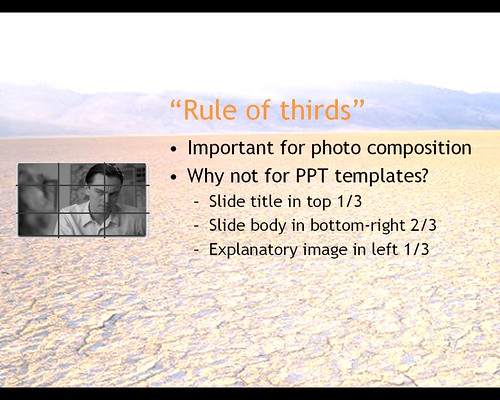
if the “rule of thirds” is so effective for photo composition, could it also be used to create more pleasing Powerpoint presentation designs?
An example of the layout dimensions could be like this (don’t focus on the boring picture/font, just the relative placement):
Rule of thirds for Powerpoint (no rules)

iPod in 2009: more storage or bandwidth?

I had an interesting discussion some days ago: will the iPods move to more storage (e.g. the Terabyte iPod) or more bandwidth (Bluetooth, EDGE, Wifi). Let me sketch what those two scenarios for the future iPod look like:

2009 iPod as personal media storage

iPod Video 16:9That new iPod ‘3D’ might not be much bigger than the current 60GB iPod video, but it has a better 16:9 screen, and way more storage. It ships with a 500GB Flash card that is replaceable. You typically buy more storage cards: 1 for all your music, 1 for essential movies (with that Hitchcock and Tarantino collection), 1 for TV series (one season is around 15GB) and fill them up from your 50TB home media set-up.
The sleek white player has wireless USB and uses wireless battery reload (with magnetic holder) so you don’t need a cable for anything. Your 5.1 headphones: wireless. Copying from that 50TB iTunes/Tivo media station: wireless. Hooking it up to an HD-TV: wireless. Sure, it has Gigabit Wifi too (which is really only around 250Mbps, but we’re used to that from the 802.11 guys), but not everyone uses that yet, certainly not in that Ardennes village where you booked that small hotel for your “24” marathon (12 seasons, who would have thought? Thank god for the 2x hi-speed viewing mode).
It can obviously play the new “3HD” (3-dimensions) standard, which is really neat if you have one of those new holographic projectors. If you have subscribed to the (rather expensive) iTunes ‘Premium Hollywood’ service, you get all new movies on your iPod at the same moment when they are released in the cinemas. You only get them at consumer-grade HD resolution (2048×1080 – looks OK on that 50″ screen), not at the new DCI 8K standard for movie theatres (8192×4320 with HDR) but who’s complaining.

A Sudoku challenge generator

When on holiday, one can kill time solving Sudoku puzzles. When one has done a dozen of those puzzles and one happens to have a wandering mind like mine, one starts wondering how those Sudoku challenges are created, and if it would be possible to describe an algorithm that can make such a scarcely filled-in 9-by-9 grid. Some sunny hours later one has a system that might work (I haven’t implemented it fully yet). For my future reference: here’s how I would do it.
REMARK: this algorithm is quite logical and as such, I seriously doubt I would be the first one to think of it. I can imagine that Sudoku puzzles are already made by the hundreds with a program that uses this or a quite similar system. I’m not claiming it’s an original ‘invention’, just a fun problem to tackle.

Step 1: take a good root grid

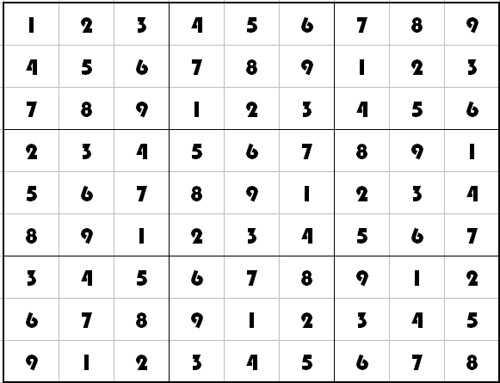
Let’s start with an completely valid Sudoku filled-in grid. Any one would do, I take the one that has 1-2-…-9 in the top row, and in the top left 3×3 square:
Step 1: start layout

Barcamp Brussels #2: on Sunday Sept 24th

We have just decided on the location and date for the new Barcamp Brussels:

WHEN: Sunday Sept 24th 2006 (back to back with EurOSCON, GovCamp and DrupalCON)
WHERE: Skynet Lounge, in K-NAL building next to Brussels harbour

As you can guess from the location, Skynet has been confirmed as the principal sponsor again (thx Bart and Clo), which allows us to provide a nice and stimulating surrounding for our speakers/attendees.
(…)

If you want to participate, the first thing you need to do is to add your name to:
http://barcamp.org/BarCampBrussels

via barcamp.forret.com

How to visualize a timeline

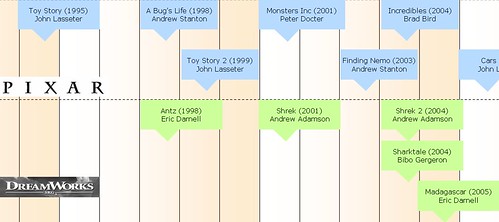
I am working on a timeline of animation movies: specifically to see when Disney started to fade and Pixar/Dreamworks took over. What films were made when, who made them and in what way do they coincide with activities of e.g. Steve Jobs. Oh, and to see where that new contender, Blue Sky Studios (“Ice Age”) fits in.

I first started out with Excel: I figured I’d have a bunch of dated events and throw a quick XY chart onto it. But that didn’t feel right. I then turned to Powerpoint and created a horizontal timeline, on which I could place blocks. That works OK for events that are far apart, but not for a quick succession, nor for events with a duration (from … to …). And, frankly, it looked rather ugly:
Timeline: animated movies

Which left me with two questions:

  1. how do other people create their timelines, and
  2. are there on-line tools that let me do it easily?

Trackback wizard for Blogger users

Trackbacks are a good way to alert other bloggers that you citing them on your blog. It also helps to drive traffic to your own site (if your comment was insightful or tempting).
Unfortunately, some blog hosts like Blogger, Skynetblogs do not automatically send a trackback ping to all the blog URLs in your blog post. So how do you send such a trackback from your blogspot.com site to other blogs (provided they support receiving them, obviously)?

Owner of the “Amen Break”

I (used to) have a blog called Sample Spotters that talks about whose songs have been sampled by whom. With the help of sites like the-breaks.com and datraxer.com, I make a list of an artist’s songs and where they were used: e.g. Roy Ayers, Patrice Rushen or Labi Siffre. I also did it the other way round once (what songs were sampled BY George Michael), and for some pivotal songs, I dedicated a whole blog post to just 1 song: Funky Drummer and the “Amen Break”.

Google and Perfect10: DMCA at its best

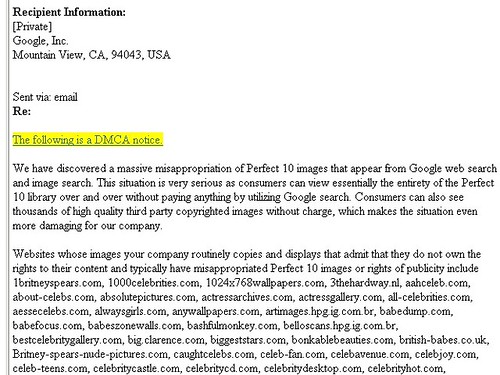
While searching for something really innocent on Google (honestly!), I got the following warning:
Google DMCA warning: OMG

The Digital Millenium Copyright Act (“DMCA” – 1998) criminalizes production and dissemination of technology that can circumvent measures taken to protect copyright, not merely infringement of copyright itself, and heightens the penalties for copyright infringement on the Internet. OMG, what kind of illegal practices had Google just protected me from? Clicking the ChillingEffects link shows the DMCA complaint in question: the Perfect 10

Google DMCA explanation: WTF