Skip to content

Peter Forret

More fun with Myers-Briggs

I’ve been reading quitea lot on Myers-Briggs for my previous post “Myers-Briggs typology“, and some of it is too good not to post it here, so here is my second MBTI post! I’ve also made an new MBTI web tool for my web tools collection, that you can use to quickly check the facts for each type.

MBTI at first sight?

Get this: according to socionics, it is possible to do Visual Identification (V.I.) of the Myers-Briggs type. They prove it by showing 4 pictures (Malcolm McDowell, Sting, and two familiar actors-I-can’t-name) with -granted- similar features, and they’re all ISTJ (Sting a duty fulfiller?). I’ll be honest, I don’t buy this. I know that you can sometimes guess character traits from someone’s face (e.g. a ‘kind’ face vs. a ‘hard’ face), and I can understand how your physical attributes (pretty/ugly, thin/chubby) might influence your behaviour and consequently your MBTI type, but I’m not sure this method would withstand a critical scientific eye.
MBTI: visual identification

Myers-Briggs typology: I’m an ENFP

Background

I have never been a big believer in astrology. I am not convinced the location of stars at the moment of your birth is that important to your personality. I’m a Virgo, but I don’t feel that defines me that much. But some years ago I discovered a ‘labeling’ system that was based on the actual behaviour of a person, whose result was much more significant: the (Jung) Myers-Briggs Type Indicator (MBTI):

According to Jung’s typology all people can be classified using three criteria. These criteria are: Extraversion/Introversion – Sensing/Intuition – Thinking/Feeling
Isabel Briggs-Myers added a fourth criterion: Judging/Perceiving
from humanmetrics.com

A good explanation of each criterium is:

  1. Where, primarily, do you prefer to direct your energy?
    If you prefer to direct your energy to deal with people, things, situations, or “the outer world”, then your preference is for Extraversion. This is denoted by the letter “E”.
    If you prefer to direct your energy to deal with ideas, information, explanations or beliefs, or “the inner world”, then your preference is for Introversion. This is denoted by the letter “I”.
  2. How do you prefer to process information?
    If you prefer to deal with facts, what you know, to have clarity, or to describe what you see, then your preference is for Sensing. This is denoted by the letter “S”.
    If you prefer to deal with ideas, look into the unknown, to generate new possibilities or to anticipate what isn’t obvious, then your preference is for Intuition. This is denoted by the letter “N” (the letter I has already been used for Introversion).
  3. How do you prefer to make decisions?
    If you prefer to decide on the basis of objective logic, using an analytic and detached approach, then your preference is for Thinking. This is denoted by the letter “T”.
    If you prefer to decide using values and/or personal beliefs, on the basis of what you believe is important or what you or others care about, then your preference is for Feeling. This is denoted by the letter “F”.
  4. How do you prefer to organise your life?
    If you prefer your life to be planned, stable and organised then your preference is for Judging (not to be confused with ‘Judgemental’, which is quite different). This is denoted by the letter “J”.
    If you prefer to go with the flow, to maintain flexibility and respond to things as they arise, then your preference is for Perception. This is denoted by the letter “P”.

from teamtechnology

Estimating real-time traffic speed

— This is a post from 2006. Back then, there was no Google Maps, no Waze, no iPhone, no mobile data —

I was reading a magazine on affordable GPS systems and one of the features they stressed a lot was the support for TMC (Traffic Message Channel). This is the reception of real-time traffic info that is digitally transmitted alongside an FM channel. So I wondered where that data came from: how sophisticated the traffic detection schemes were.

Invent, don’t inhibit

1982

25 years ago, the last real proof of innovation coming from the recording industry:

In 1979 Philips and Sony decided to join forces, setting up a joint task force of engineers whose mission was to design the new digital audio disc. Prominent members of the task force were Kees Immink and Toshitada Doi. After a year of experimentation and discussion, the taskforce produced the “Red Book”, the Compact Disc standard. (…)
According to Philips, the Compact Disc was thus “invented collectively by a large group of people working as a team.”
from en.wikipedia.org/wiki/Compact_disc

Three years of constructive working and a new technology was developed that was revolutionary superior.

In August 1982 the real pressing was ready to begin in the new factory, not far from the place where Emil Berliner had produced his first gramophone record 93 years earlier. (Deutsche Grammophon, Berliner’s company, had by now become a part of PolyGram). The first CD that was pressed in Hanover was a recording of Herbert von Karajan conducting the Alpine Symphony by Richard Strauß. In January 1983, 500 working days after the start of production, half a million CDs had been made.
from research.philips.com

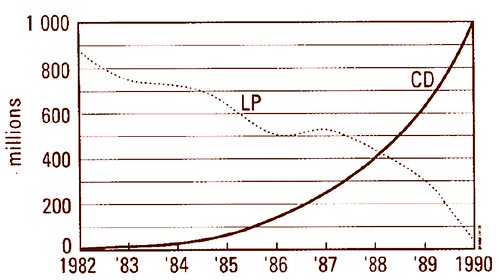
The CD was an instant hit and made a lot of companies a lot of money:
CD versus LP

Barcamp Brussels: when the day is done

And what a day it was! It went by in a rush, without any major mishaps and with lots of smiling people all around. Me, I just ran around on adrenaline and cafeine (probably equal parts), while catching only the occasional 5 minutes of a speech here and there. But at the end of the day: it was a great atmosphere with lots of interesting topics and charming people eager to learn and share. It was everything I hoped it would be, so I’m a happy man.

Yesterday I was browsing through my freshly arrived Tufte book “The visual display of quantitative information“. One example of “garbage in, garbage out” that he gives is the London Stock Exchange index (which went way down one year in Dec) and the solar radiation in that same year (which obviously also went down in the winter). Plotting both lines in the same graph gives the impression of correlation (Stock Exchange went down because of lack of sun).

Now take a look at this chart:
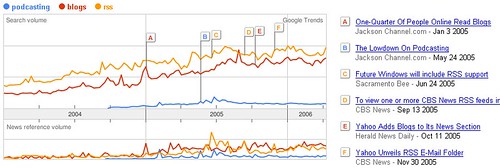
Google Trends: RSS

This seems to imply that, since the term “RSS” is more searched for than “blogs”, that RSS is more popular than this whole “blogs” thing, right?

And this is exactly what was written in businessweek.com. It was cited by socialsoftware.weblogsinc.com, who -to their credit- added the wise remark that:

To be honest, I do think that RSS is as important as I said above, but in terms of use frequency it’s also got the semantic advantage of only having one tense. People will write about and search for blogs, blog and blogging for example – but RSS is a one-term wonder.