1969 was an inspiring year

Russell Lichter writes the Monthly Mix Challenge blog: interesting monthly lists of songs on particular themes: e.g. titles with the word ‘hate’ in them or female drummers (that I mentioned earlier).
Russell Lichter writes the Monthly Mix Challenge blog: interesting monthly lists of songs on particular themes: e.g. titles with the word ‘hate’ in them or female drummers (that I mentioned earlier).
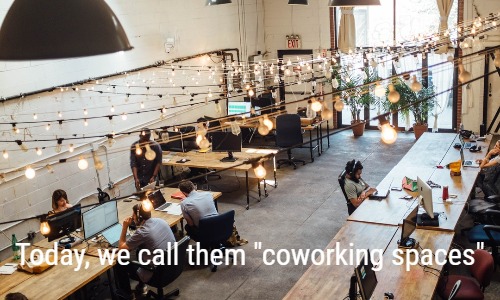
Anyone who often works at home is probably familiar with this: sometimes you would like to work somewhere else to finish something undisturbed, to see some people while you work instead of just the PC and the refrigerator, to have a meeting in a pleasant location, to be in another environment. I often do some work at the Recyclart or the AB Café, and almost always I’m the only nomadic worker there. Both places are cosy and have free Wifi, but they’re not real offices: there is no printer, no meeting room, no water cooler. And since I don’t pay for the accommodation, I feel obliged to order stuff. When I’m hungry, that’s OK, when I’m not, drinking 3 coffees in a row transforms my ADD into ADHD .
I would be glad to pay something between €50 to 100 per month to have a place in Brussels where I can drop by anytime, get some work done (wifi, printer, fax, meeting room, beamer) and maybe have some stimulating conversation with other people present. So when I read about “BEING SPACES”, it really struck home:
(…) urban dwellers are trading their lonely, cramped living rooms for the real-life buzz of BEING SPACES: commercial living-room-like settings, where catering and entertainment aren’t just the main attraction, but are there to facilitate small office/living room activities like watching a movie, reading a book, meeting friends and colleagues, or doing your admin.
from trendwatching
I’ve written a post on the BMI (Body Mass Index) of the candidates for Germany’s next Top Model and I have been mentally bugged ever since. Not by images of thin girls, but by the formula of BMI: weight(kg) / length(m) ^ 2 = kg/m².
Why the square of the length?

If the formula were weight/length you can attach a mental image to that: if you took horizontal slices of the body, how much would a 1m high slice weigh? For weight/length³ you can have an image too: kg/m³ or density of the body.
But BMI is kg/m² or something like ‘pressure’ (multiply it with gravity 9.81 m/s² and you get the unit of pressure: Newton/m² or ‘Pascal’).
One of the reasons why I have been posting less the last couple of days, is because I was working on a migration from Blogger to WordPress. I was still working out some DNS stuff (don’t let me get into that, it’s complicated stuff , to do with how Bluehost‘s -my hosting provider- DNS management works).
So I was just writing a piece on how Google bought Writely with my w.bloggar local client, and when I publish I get an error: “Post was saved as draft, please log in to http://www.blogger.com/ to publish it“. Weird, never have that normally. Anyway, I log in, get the Blogger CAPTCHA ‘word verification’ box and I publish. But I see no changes on blog.forret.com. I publish again. Nothing. Then I click the ‘View Blog’ tab in my Blogger interface. This is what I see:

Apparently:
Google has just confirmed to have bought Upstartle, the creators of Writely (Writely Blog/GoogleBlog via Om Malik). Apart from being good news for the founders of Upstartle, this also indicates Google’s determination to make the fat client history and allow users to do all their business through on-line services.
Now buying Writely is in line with Google thinking of using browser for everything. I mean an online word processor, and online excel spread sheet make a lot more sense than making people switch to OpenOffice.
Om Malik
Om started making a Microsoft office/Google Office comparison matrix, and I took the liberty of adding some stuff to it:
I will list a number of (‘productivity’) application types, with the current (‘fat client’) most used software, and the on-line web2.0-ish (‘thin client’) applications that are trying to take over (although for some areas the online applications are only just at the beginning):

In November last year, Doc Searls published a lengthy article in LinuxJournal: “Saving the Net: How to Keep the Carriers from Flushing the Net Down the Tubes“. It is an essential piece of reading.
This is a long essay. There is, however, no limit to how long I could have made it. The subjects covered here are no less enormous than the Net and its future.
The topic of the essay is this: the big (telco/media) corporations are dying to take over the Net, manage it the corporate style and charge for any use of the Internet. At the same time they want to get rid of the wild, pioneering spirit that brought us avalanches of innovation and the occasional disruptive force like Amazon, Ebay, MP3 and BitTorrent.
I wrote about digital cinema earlier. I want to focus now on the distribution of movies to theatres.
A number of influential international writers, journalists and intellectuals have just released a manifesto: “Together facing the new totalitarianism”, stating that we need to protect the universal rights (freedom of expression, equality of man and woman, …) from attacks by militant muslims.
After having overcome fascism, Nazism, and Stalinism, the world now faces a new totalitarian global threat: Islamism.
(…)
We reject «cultural relativism», which consists in accepting that men and women of Muslim culture should be deprived of the right to equality, freedom and secular values in the name of respect for cultures and traditions. We refuse to renounce our critical spirit out of fear of being accused of “Islamophobia”, an unfortunate concept which confuses criticism of Islam as a religion with stigmatisation of its believers.
Jyllands Posten via michellemalkin.com
The authors are the following 12 people: Ayaan Hirsi Ali (NL), Chahla Chafiq (FR), Caroline Fourest (FR), Bernard-Henri Lévy (FR), Irshad Manji (CA), Mehdi Mozaffari (DK), Maryam Namazie (US), Taslima Nasreen (SE/US), Salman Rushdie (UK), Antoine Sfeir (FR), Philippe Val (FR), Ibn Warraq (US).
It’s been a while since I was really pleasantly surprised by a new Belgian group (Moiano comes to mind) but it just happened again. I was humming along to the little pearl “Troubles and Fights” by Lalalover – “Wow, who’s that?” – and then I find out it’s a Belgian group started by Tom Kestens – former multi-instrumentalist with das pop.
Check out the song performed live on “De Laatste Show” – the supporting singer is Belgium’s best soul voice Stef Caers, of Moiano and Krewcial fame.

(8MB – WMV file)
According to Pantone, Inc., the global authority on color and provider of professional color standards for the design industries, blue dominated the palette, with three shades – Deep Ultramarine, Skyway and Blue Tint – placing in the top 10
from Pantone website
I took the liberty of converting them to RGB with the CMYK-RGB Converter:
 I’m in the restaurant of the Ancienne Belgique and it’s only a few steps away from heaven:
Joey from “Friends“, as we all know, is very interested in bio-mechanics, certainly the topic of female movement on beaches: